Showing posts with label 18th century. Show all posts

Tuesday, February 11, 2014

An article on stage makeup in the 17th and 18th century

Some time ago I was asked by Talia of The Gibson Girl's Guide to Glamor if I wanted to write an article about stage makeup in the 17th and 18th century for a website she runs about Commedia dell'Arte. Which I, of course, wanted and you can now read the article here.

I wish I could have found out more, but if there is a work especially on stage makeup for these centuries, then it has eluded me. 16th century and 19th century yes, but not for 17th and 18th century. I think it is a very interesting subkect, though.

David Garrick as John Brute in 'The Provok'd Wife' by Vanbrugh, Drury Lane by Johann Zoffany, 1763

Saturday, January 04, 2014

At the vanity, 1750-1800

You may have noticed that the mythological ladies primping themselves are gion ein the 18th century. There are, of course, plently of allergorcal nakedness elsewhere, but the vanity is now for the ordinary lady, with or without an entourage of maids and friends.

This charming lady has a small pot of rouge on her table and either a swandowns puff for application, or perhaps just some crumpled fabric.
Portrait of Madame Courcelles by Jean-Baptiste Greuze

Alexander Roslin, 1755-1760
The Toilet, 1760

A lady at her toilet in an interior by Abraham Hendrick van Beesten, 1762
 
Van Loo

Powder box with a powderpuff with a handle as well as a cabinet that sems to contain bottles of various kinds.
Source
Powderbox with puff and a small brush beside it. I winder to what? Powdering face, rouge, clothes?
A family scene by Johann Heinrich Wilhelm Tischbein, 1778

A Woman at her Toilet with a Maid, a Boy, a Dog and a Young Soldier; verso: A Sketch for a Similar Composition by Johann Eleazar Zeissig, called Schenau, 1770
 
The Morning Toilet by Pehr Hilleström
 
The lady and her maidservant at the morning toilet
 
 
 Not an ordinary toilet room but an actress dressing room, but it is worth noting that she has just about the same thing on it as other ladies.
An Actress at Her Toilet, or Miss Brazen just Breecht, anonymous artist after John Collet, 1779

Pehr Hilleström

My favourite pictures are those were you get a glimpse on how the hairstyle is constructed. Here you get a view on both the front and the side.
Mademoiselle Du T... by Jean-François Janinet, 1779


Source
 A hair that has completely broken down.
The Broken Mirror by Jean-Baptiste Greuze, 1763
Two back views that clearly shows how hairstyles was worked in sections, first the front, and then one could arrange the backhair in curls, braids, etc.
An Interior With A Young Lady At Her Toilet, Combing Her Hair Before A Mirror by Johann Anton de Peters

A woman combing her hair in front of the mirror by Pehr Hilleström
What to do when one hasn't got a special powder room. Protect the furniture with a screen and draped curtains and protect the floor with a piece of cloth.The lady herself is swathed in a powder cape.

La Coiffure by Baptiste Mallet

 
The Toilet by Robert Sayer, London. 1786


The English Dressing Room, Stipple engraving by P. W. Tomkins after Chas. Ansell published 1789

Lady with attendant, engraving by Jean Francois Janinet after Nicolas Lawrence
 
The Coquette at her Toilet, after George Morland


Dressing for a ball, 1797
There is an abundance of satirical drawings depicting vain men and women in the 18th century, but the items of the dressing table looks just about the same as in more serious paintings.

Frontispiece to Anstey's election ball, 1776

The Lady's Maid or Toilet Head Dress, 1776
 
Source


The English Shaver of Frenchman in the Suds, 1772

Source


The Coiffure, model attributed to Gottlieb Friedrich Riedel, c. 1770

Thursday, December 26, 2013

At the vanity, 1700-1750

Madame has a number boxes and pots, one undoubtly for powder and one for jewelry. There is also a large brush behind the mirrror that looks like it is meant for clothes. It is worth noting that everything on the vanity is a matching set. Colour and shape suggest laquered goods from China. She seems to be in the process of applying rouge while listening to what the visiting priest is reading.
La toilette de Madame Geoffrin by Nicholas Lancret (1690-1743)

The lady above use her fingers for her rouge, but Madame de Pompadour use a small brush to apply hers. It might have been a matter for preference, but a rouge based on fat is easier to apply with the fingers and a dry one with a brush, so that might also be a reason. The powder puff with the small handle is meant to freshen up the powdered hair. An illustration plate from Encyclopédie Méthodique, Arts Mécaniques show a very similar puff.
 
Madame de Pompadour at Her Toilette by François Boucher, 1750's

Similar rouge box and brush.
Enamelled gold box for rouge and patches with brush by Joseph-Etienne Blerzy, 1780-1782
This unknown lady is in the process of applying her patches, the lid of her patch box showing a portrait of a man, probably her lover. One can suspect that the powder puff, which looks exactly the same as the one of the portrait of Madame de Pompadour, was one of Boucher's props.
A Lady Applying A Beauty Patch by Francois Boucher
It seems to have been quite popular to have been painted with a patch ready at a finger tip. More matching, probably laquered boxes. I wonder if it is the handle of a brush we are seeing.
Anne de La Grangem Trianon by François-Hubert Drouais, (1727-1775)
 
La Mouche, A Lady at Her Toilet by Louis Tocque

Beside the patch box there are also a jewelry box and a rouge brush on the vanity. And a cylindrical etui, which I am curious about. anyone who knows what it was used for? Needles perhaps, though it seems a bit too big for that.
Portrait of Marquise de Gast by Donatien Nonnotte, 1743
Despite being a charicature, the vanity table looks very much like they do on more serious pictures.
La Folie Pare La Decrepitude Des Ajustements De La Jeunesse by Charles-Antoine Coypel (1694-1752)
Many vanity tables on 18th century paintings seems to have been especially furnished for that purpose, with cloth fitted over them, but there are also paintings were the table have several purposes. There is also a charming drawing by Sergel, which I can't find online, of a lady getting her hair dressed by her maid in the kitchen, while food is being prepared in the background.
A Lady at Her toilet by Jean Raoux, 1727
Queen Caroline at Windsor at her dressing table with her two oldest children, the Prince of Wales and the Duke of York:by Johann Zoffany
Circle of The Master of the Reflessi
 
François Hubert Drouais

 A lady in the process of powdering her hair
A Lady at her toilet table, dressed in a peignoir by an unknown artist, c. 1750
Not a vanity painting, but I include it because the little girl still have her curling paper in her hair, a nice peek into the process of dressing hair.
Madame Liotard and her Daughter by Jean-etienne Liotard (1702-1789)


Saturday, November 09, 2013

Movies and the 18th century

Late 19th century masquearde costume. More
pictures can be seen in an old blog post of mine, but
I'm sorry to say that the original source is lost.
Do an image seek on “18th century makeup” and you will get all sorts of pictures, but as often as not you will see a makeup tat consist of a very white face, rouge in small spots on the cheeks, eyebrows that have been painted over and re-painted much above the natural ones and a rouse-bud mouth painted smaller than it actually is. Quite often there are green and blue eyeshade, a painted on patch and to top it off, a shiny white wig. From a historical point of view, almost everything is wrong with this makeup. The white face: True, white makeup was used in the 18th century, but modern white makeup is pigmented with Titanium oxide, which actually cover up more than the original lead white. The modern makeup is too white! There are lead substitute available here, which is a mix of pigments to mimic actual lead white. The eyebrows: There are absolutely no suggestions that eyebrows were placed anywhere lese than on their natural place. Neither were they thin lines, but rather groomed but natural in shape. There is evidence of false eyebrows, but nothing that indicates that they were place anywhere else than on the natural place. Eye shadows in any colour were not used in the 18th century. The mouth: A small mouth was considered beautiful, but it was never painted smaller. The small patch of rouge isn’t wrong, though, sometimes rouge were placed like that, but patches were not painted on, they were made of fabric.

 
Generic 18th century wig that has nothing to
do with the actual 18th entury.
But even if the makeup is not especially accurate it still signals 18th century to us and that is its purpose. This is a stage makeup, which explains why it is so exaggerated- it is made to be visible and easily recognizable from a distance. It is a symbolic 18th century look and I thought it could be fun to see how the 18th century have been portrayed by photos and movies sine the 19th century.


The white wigs which are so synonymous with the 18th century are, more or less, a 19th century invention. Of course white wig were available in the 18th century, but the most common thing seem to have been to use a wig in a more natural colour. Women, usually, wore their own hair with fake braids and hair loops, if necessary and both sexes powdered their hair. But even if the powder was stark white, the effect on hair is a bit different. Only white or very blond hair becomes white, other hair colours get various shades of grey. But in Victorian masquerades and plays white wigs were used, a faster and less messy way to get the desired Rococo hair.


The white wig was picked up by the movie industry, but, as it photographed better, shiny wigs were chosen, rather the opposite of the dull powdered look that had been fashionable in the 18th century.
 
 Early movies demanded a rather un-natural and heavily made up look to come through on the white screen and part of that was heavily painted eyes. (As a happy coincidence I found a link through The Gibson Girl's Guide to Glamor that explores just this subject, read it here.) If the pale face corresponded well with historical facts, they were rather due to looking good rather than trying for an accurate look.
Theda Bara playing the Vamp, I mean Madame du Barry in 1917. Not much 18th century, very much Theda Bara.
Source
Ziegfeld girl, Marion Benda c. 1920’s
 
Rudolph Valentino and, I think, Bebe Daniels in Monsieur Beaucaire, 1924
 
Betty Compson - c. 1920s
 This masquearde outfit is actually more accurate than the movie and dance ones above.
Marjorie Post Hutton, as Marie Antoinette, c. 1926
In fact, throughout decades of movie making and even today, makeup and hair in period movies have varied between more or less accurate, most usually less. Up until the 1960’s or so, an actor or actress had a set look that had to remain the same regardless of where, and when, a movie took place. Rita Hayworth’s trademark, for example, was her long, red hair and when she appeared in short, blond hair in The Lady from Shanghai, the audience was not pleased. Makeup was therefore always perfectly modern and hair styled so it looked modern from the front, but somewhat more period at the back
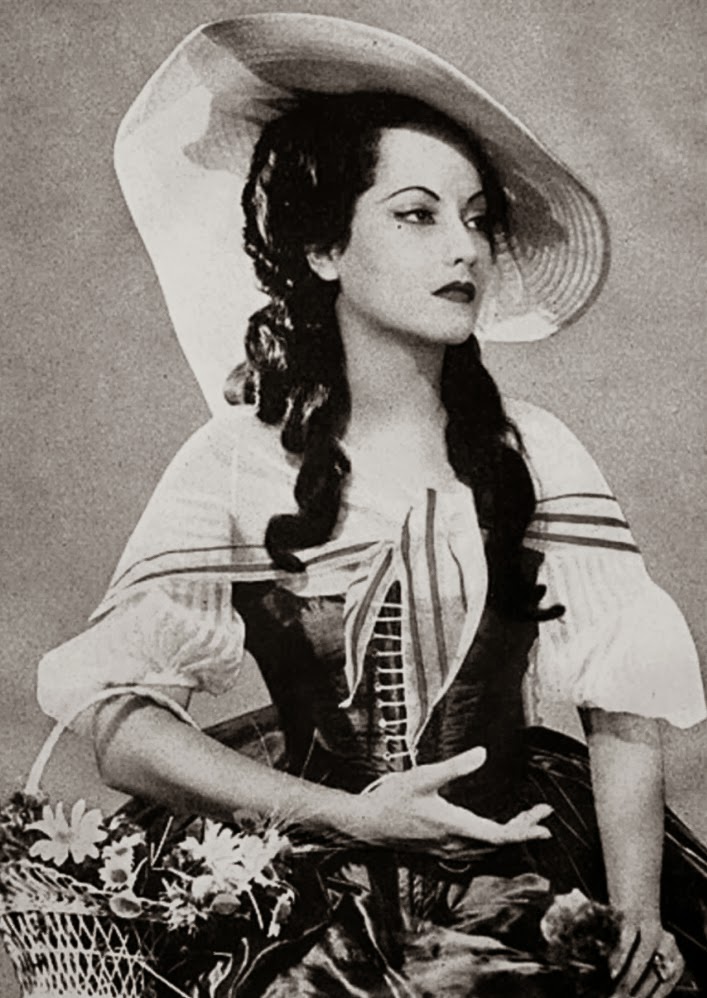
Stunning Merle Oberon in The Scarlet Pimpernel from 1934, probably the main reason, along with Singin's In the Rain, that I fell in love with the 18th century. Her makeup is her standard Hollywood heroine look and the hair too sleek and flat for an early 1790's look. 
Source
Leslie Howard's hair is pure 1930's apart from a few curls at the temples that are slicked down in his face.

Source

Marion Davies in Hearts Divided, 1936
Marie Antoinette from 1938, a beautiful movie, but not especially accurate when it comes to hair and makeup. Tyrone Power's slicked back hair in perfectly contemporary, but with an added pigtail at the back to give a period air. Norma Shearer's hair looks a bit better then, but borrow style elements from the 1930's.

Source

Source
Many of the wigs were re-used for other movies, like Du Barry Was A Lady from 194. Lucille Ball wear her trademark makeup and why this wig is pink I don't know. Perhaps it was an atempt to mimic coloured hair powder.

Source
The 1950's do the 1920's do the 18th century. 
Jean Hagen in Singin's In the Rain, 1952
 Du Barry again, in a hairstyle that would have worked perfectly for a 1950's party too.

Martine Carol in Madame du Barry, 1954
Apart from the token que, hairstyles on both Albert Finney and Susannah York looks more contemporary than anything else.

Tom Jones, 1963
Barry Lyndon from 1975, introducing a new standard in period hair- the wigs are beautiful! The makeup is properly pale, but the rouge is placed after the fashion of the 1970's and there are too much eye-makeup.

Marisa Berenson
The past 40 years, or so, more effort has been made to make accurate hair and makeup and nowadays the hairstyling usually look quite good. Makeups are more of a hit and miss. The rather un-natural look of the 18th century with white skin, red cheeks and no eye-makeup doesn’t fit well into modern aesthetics and movie makeup usually go a more neutral makeup route with pale skin and very discreet eye makeup. Because another reason for not going for historical accuracy is to not alienate the audience.  A too period correct look may look odd or even ugly to the modern eye. For example, when The Scarlet Pimpernel was made into a TV-series in 1999, lady Blakeney, played by Elizabeth McGovern had a pretty correct period makeup and plenty of reviewers noted that Marguerite wasn’t beautiful enough and looked clumsily made up and that even though McGovern is pretty gorgeous in herself. The hair wasn't especially exiting, though, on either sex.


Richard E. Grant, Elizabeth McGovern and Martin Shaw
 Jane Seymour with rather good hair and a pure early 1980's makeup.

The Scarlet Pimpernel, 1982
 The wigs in Amadeus, 1984, are just plain crazy.

Tom Hulce
Dangerous Liasions, 1988, is probably one of the best costume movies ever, and the hair is really good. The makeup tend toward neautral/pretty accurate, but the rouge is usually placed after contemporary fashion.
Glenn Close, John Malcovich and Michelle Pfeiffer
 My favourite hairmovie, however, is the mini-series Aristocrats from 1999. Spanning most of the 18th century, hairstyles change accordingly. The picture here shows the three actresses who plays Lady Emily Lennox at different stages of her life.

Geraldine Sommerville, Hayley Griffiths and Siân Phillips
If you find the subject interesting, I really recommned Hollywood and History, Costume Design In Film by Edward Maeder, Alicia Annas, Satch Lavalley and Elois Jensen