Showing posts with label 17th century. Show all posts

Sunday, May 11, 2014

I have written an article about 17th century hair for Your Wardrobe Unlock'd

Lady Margaret Tufton by David des Granges, 1638-1650
Some time ago, in February, I approached Your Wardrobe Unlock’d and asked if they might be interested in two articles about 17th century hair and makeup. To my delighted surprise they were and the first article went live today. I feel quite exited, I can tell you! The subject is the woman’s hairstyle that was popular for the whole mid-part of the 17th century where the hair was put in a chignon in the back and the side hair was hanging down around the ears. In my article I go through the key variations of it and also how to set and style a wig. The next article that will be up next month, is about makeup during the same period.

You can read, if you subscribe to Your Wardrobe Unlock’d, here.

Tuesday, February 11, 2014

An article on stage makeup in the 17th and 18th century

Some time ago I was asked by Talia of The Gibson Girl's Guide to Glamor if I wanted to write an article about stage makeup in the 17th and 18th century for a website she runs about Commedia dell'Arte. Which I, of course, wanted and you can now read the article here.

I wish I could have found out more, but if there is a work especially on stage makeup for these centuries, then it has eluded me. 16th century and 19th century yes, but not for 17th and 18th century. I think it is a very interesting subkect, though.

David Garrick as John Brute in 'The Provok'd Wife' by Vanbrugh, Drury Lane by Johann Zoffany, 1763

Sunday, December 08, 2013

At the vanity, 1650-1700

There are significanly less goddesses who preen themselves in front of a mirror in the latter half of the 17th century, but a lot of Dutch middle class ladies, which is rather more interesting for this blog.
 
Not a very good copy, but she seems to be holding a small box and she is holding her hand in the same way ladies do on 18th century paintings when they are applying a beauty patch, so I believe this is what she is doing here as well. 
A lady at her toilet by Jan van Noodt, 17th century
Not much can bee seen on the table apart from the mirror and a round box, but it is interesting to see the hairstyle from the back.
Woman at A Mirrir by Gerard Terborch the younger, ca. 1650
Mirror, a large round boc, a smaller squarer one, a comb and a necklace, or possible just a piece of string. And a rather large brush, which function I wonder about. It is round and the handle is straight, which would probably make it difficult to use as a hair brush. A clothes brush, perhaps? Or possible used to brush white powder onto the skin, the lady is certainly pale enough. What do you think?  (Follow the link under the picture and you will be able to zoom in on it.)
A Young Woman at Her Toilet with a Maid by Gerard Terborch the younger, 1650-1651
I think the red pillowlike shape is a pin cushion. If that seems like a strange thing to have at the vanity, remember that it was very common to use pins to secure clothing. There is also a small brush. Another version of this painting can be seen here.
Lady at her toilet by Gerard Terborch the younger, 1657
Women at her toilet by Gabriel Metsu, ca.1658


Lady at her toilette by Gerard Terborch the younger, 1660
 
A young woman at her toilet by Gerard Dou, 1667
Portrait of a lady by Gabriel Metsu, 1667
The love letter by Jacob Ochtervelt, ca. 1670
Another of these brushes with a straight handle.
Woman at her toilette by Frans van Mieris, 1678
A gigantic comb and dito brush Or is it a very full pin cushion? 
Recueil des modes de la cour de France, 'Fille de Marchand, estant à Sa Toilette' by Nicoals Arnoult, 1687
A lot is going on here, boxes and bowls on the table as well as a pin cushion. Hot water is arriving and what is the maid with the bowl doing. She may be holding a wash cloth and holding a washing bowl, but my first thought was that she was applying white paint.
The Morning, Lady at her toilet, engraving, late 17th century
 
The evening routine seems much less ardous.
The Night, Lady going to bed, engraving, late 17th century


Late 17th century engraving
Is she holding a hair pin or is she in the process of painting her eyebrows?
Madama la Marquise Dangeau at her Toilet, engraving, 1694

Portrait of a woman by Nicolas de Largillière, 1696

La toilette, Turkish school, around 1700
This really belong to the previous post as it is from the 1630's, but I only found it today and I had to include it, as this is a rare depiction of a man making himself pretty. Notice that he is fixing his love lock. 
A Cavalier at His Dressing Table by Adriaen van de Venne, 1631

Wednesday, November 27, 2013

At the vanity, 1600-1650

In the 17th century the vanity tables gets gradually more filled up. Also, more paintings depict scenes that are just ordinary women doing their beauty routine and not godesses. Of course, allergorical paintings have always been a great excuse for painting naked ladies, so they aren't completely let off..

The Toilet of Venus by Peter Paul Rubens, 1613

Or nearly naked ones.
 
Vanity by Francesco Furini
 
Ribbons and feathers and flowers, but the ladies attending the old woman seems more made up than she is. The bared breast can probably be seen as another attempt to mimic youth.
Vain Old Woman by Bernardo Strozzi, ca. 1625.

A painting stuffed with symbolism, for example the skull the girl is resting her feet on for mortality and the monkey for vanity, the lady herself looks quite ordinary, if pretty. She has sensibly covered her clothes with a peignoir and the chaotic table with ribbons and boxes looks like it has been painted from life as well.

Allegory of Vanity by Jan Miense Molenaer, 1633
 Similar, but without the allegory. Jewelry, feathers and some intriguing boxes and bottles.
Lady At Her Toilette, Utrecht School
 Another peignoir that seems a lot less sensible.
Woman at her toilet, French school, early 17th century

Undated, but the hairstyles suggest the early 17th century. The lady is very pale and a habit of painting herself with Ceruse doesn't seem far-fetched.
Vanity- A Woman With A Mirror, Prague School, 17th century
Young Woman At Her Toilet by Rembrandt van Rijn
Lady at Her Toilette by Jacob Duck


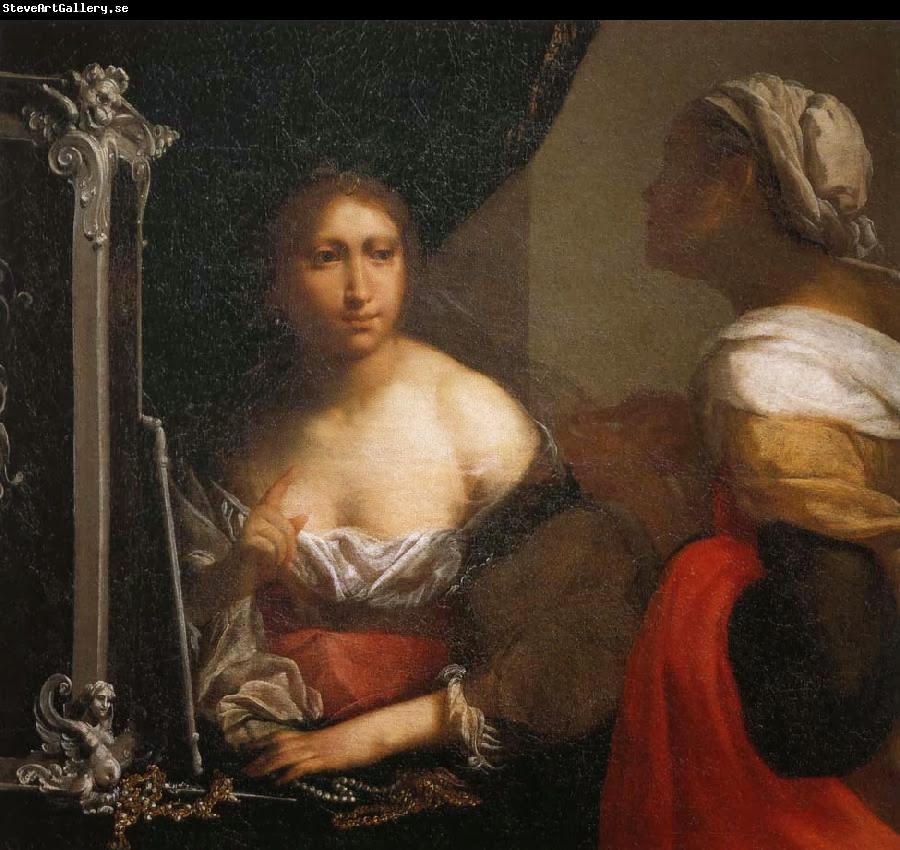
Woman at her Toilet with Servant, from La Vue (sight), ca. 1635

Monday, October 28, 2013

A review of Historical Wig Styling: Ancient Egypt to the 1830s

Source
Historical Wig Styling: Ancient Egypt to the 1830s by Alison Lowery is a book on wig styling aimed to the theatre. That doesn’t mean it is uninteresting for other people, so here is a little review.

The book is spiral bound with hard covers which both makes it sturdy and easy to leave open. There are plenty of colour photos throughout. It starts with a part where tools and techniques are discussed. There are the pro and cons of synthetic wigs and real human hair ones as well of what one should think of when it comes to design and front looks. There are a throughout section on the various ways one can style and curl hair and which tools one need. The author also points out that all the hairstyles are perfectly possible to do on a person’s real hair, though in theatre and movies that is usually a rather impractical solution.

The next section contains the period hairstyles. Each period has a separate chapter that follows the same lines; an overview of the period when it comes to important historic points and then how men’s and women’s hairstyles looked during that time. Each hairstyle has step-by-step instructions which start with the recommended wig style, setting scheme and how to do the actual hairdo. There are also a few suggestions on how to vary each style, sometimes with additional photos. 
Source
What I love with this book are the layout and the very pedagogic instructions. I think a novice in hair styling could pull off a very decent hairstyle while following the instructions. Sometimes, though, it feels like there are gaps in the style presented. In most chapters you get two hairstyle for women and one for men, but that varies. The Egyptian chapter, for example, just has one female style. The 17th century is probably the best presented with three female hairstyles that work for that era, but the 18th century has the fontange style that was popular around 1700 and then nothing at all until a 1770’s big hair followed by a hedgehog style feels like it misses a style. There are also long gaps before 1600, but as female hairstyles often were covered with wimples and veils, that may a bit more understandable.

I think this book is very useful for theatres, but when it comes to re-enactors, I think it usefulness depend on the history period you are interested in. I am happy with it as I already know quite a lot about 18th century hairstyling to bemoan the lack of styles, and also because I’m interested in the 17th century. If you do Medieval you probably won’t have much use for it. However, if you are looking to learn wig styling in general, then I think you should opt for this one and getting some historical styles as well.
Source
There is a second book that covers hairstyles during the 19th and 20th centuries, Historical Wig Styling: Victorian to the Present. I will probably get that one as well eventually and I don’t regret buying this one either. I you have limited funds, however, I think you should consider if this book really will be useful for you, or not. Amazon provides a sneak peak in thebook for those who are interested.

Saturday, October 12, 2013

A beautiful visage- 17th century male beauty

Karl X Gustaf of Sweden attributed to Abraham Wugters, before 1660
An overview over makeup and hairstyles for men in the 17th century, a companion post to A beautiful visage- 17th century female beauty. The focus is on European upper class gentlemen. I have chosen paintings that are good examples to give a sense of what kind of looks that were popular. Click on the links under each picture to see the whole painting.
Karl X of Sweden embodies quite well the ideal man of the 17th century. Short and rather less than slender, he was a hugely successful man. Winning a throne that it was by no means certain that he would, his cousin Kristina could have married and have children instead of abdicating, he was also very attractive to the ladies. And here are a few other Swedish poster boys, men known at the time for being very handsome.
  
Detail from a portrait of Gustav II Adolf of Sweden by an unknown artist, painted before 1632
 
Detail from a portrait of Maria Eufrosyne of Pfalz and her husband Count Magnus Gabriel De la Gardie. by Hendrik Münnichhoven 1653
 
 
Detail from a portrait of Count Nils Brahe the younger by A. Wuchters, seconf half of the 17th century
 
But Lois XVI who fits in better with the beauty standards of today, was also considered a handsome man.
Detail from a painting of Loius XIV by an Charles Le Brun, 1661
At this point of life, Louis had a long and beautiful hair, but when
he grew bald, he started to use a wig, making wig-wearing very popular.
 
On the other hand, Charles II who doesn't look half-bad either were not seen as handsome by his contemporaries.
 
Detail from a portrait of Charles II of England, Scotland and Ireland by Peter Lely.
In the early 17th century, men could use white paint, though one rarely sees such blatant examples as the one below. The almost metallic white sheen looks very similar to the effect Bismuth has on skin.


Detail from Portrait of a Man in Classical Dress, possibly Philip Herbert, 4th Earl of Pembroke by Marcus Gheeraerts II, ca 1810
As the century went on, some men used makeup, but in a more discreet way with flesh-coloured powder and a dab of rouge. Bulwer, the old miser, seems to have missed that more natural application of cosmetics and just moans over the fact that both men and women paint their eyes. And, of course, the awful habit of wearing an ear ring.


Patches were also worn by men.
In the beginning of the 17th century men usually wore their hair quite short and almost always with both a moustache and a small neat beard. I just had to include Karl IX, becasue his version of a comb-over must be one of the most fanciful, ever.

Detail from a portrait of Karl IX of Sweden by an unknown artist, before 1612

Detail from a miniature of an unknown man by Nicholas Hilliard, ca. 1600
Hairstyles grow longer and longer as the century progressed..

Detail from a self-portrait by Sir Nathaniel Bacon, ca. 1610
With some rather peculiar versions that mixed hair lengths, the long locks were called love locks.


Detail from a portrait of George Villiers, 1st Duke of Buckingham by Michiel J. van Miereveld, 1625-1626
 
Portrait of François de Montmorency-Bouteville, ca.1615

For several decades it was common to wear one’s natural hair long and flowing. The facial hair disappeared, first the beard and eventually the moustache.
Detail of a portrait of James Stuart, Duke of Duke of Richmond and Lennox, ca. 1634–35
 
Triple portrait of Charles I of England, Scotland and Ireland by Anthony van Dyck, 1635
 
Detail of a portrait of Francois de Vendome, Duc de Beaufort by Jean Nocret, 1649
 
Detail of a portrait of Louis Testelin by Charles Le Brun, 1648-1650
 
Detail of a portrait of a Young man of the Chigi Family by Jacob Ferdinand Voet
Undated, but Voet lived between 1639-1689, so probably 1660's.
 
Detail of a portrait of James Scott, Duke of Monmouth and Buccleuch, as a Boy by an unknown artist, 1660's
 
Detail of a portrait of Cornelis Tromp in Roman costume by Abraham Evertsz van Westerveld
Dated 1670-1690, but probably closer to 1670.
 
The hairstyle became curlier and fuller and though some may have been made from natural hair, the Allonge wig entered the stage and by the end of the century, really big wigs were the norm.

Detail of a portrait of George Villiers, 2nd Duke of Buckingham, by Peter Lely, ca. 1775
 
There were also a shorter wig, the periwig, suitable for travels, hunting or warfare.
 
Detail of a portrait of Karl XI of Sweden by David Klöcker Ehrenstrahl, ca. 1685
 
Detail of a portrait of a gentleman by Nicolas de Largillière, late 17th century
 
Detail of a portrait of Henry Davenport III as a Young Man by Jan van der Vaart ,1699

Sources

Coiffures Historiques

Corson, Richard, Fashions In Makeup, 1972

Kipar, Nichole, Male hairstyles

Pointer, Sally, The Artifice of Beauty, 2005