Sunday, October 06, 2013

A beautiful visage- 17th century female beauty

I grew a bit tired of reading about the 18th century and took a little break into the 17th instead. It is one of my favourite periods, and I think it is a pity that it isn't better loved. This is meant as an overview over makeup and hairstyles, which means that there are things I don't mention. The focus is on European upper class ladies, the gentlemen will get their own post. I have chosen paintings that are good examples, but also from known beauties, to give a sense of what kind of looks that were popular. Click on the links under each picture to see the whole painting.

Black and rowling is her eye,
Double chinn’d and forehead high:
Lips she has, all Rubie red
Cheeks like Creame Enclaritéd:
And a nose that is the grace
And Procenium of her face. /Robert Herrick
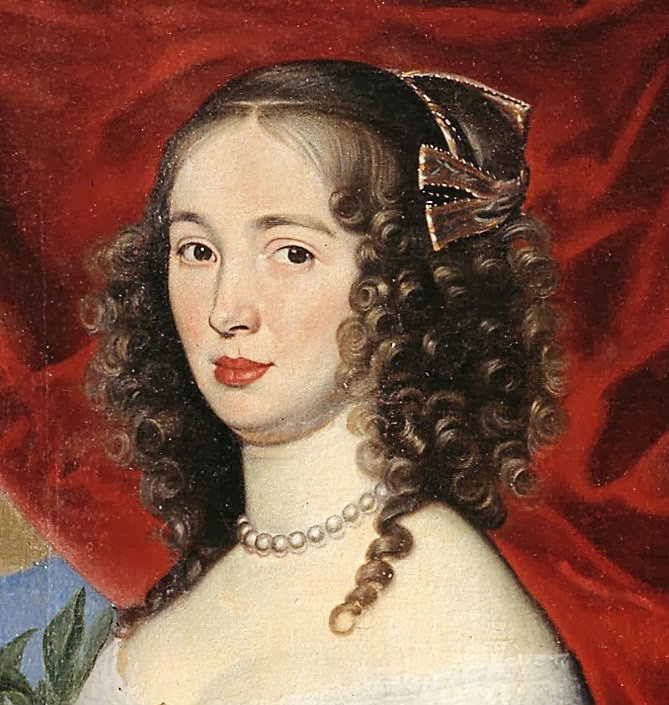
Detail from a portrait of Anna Margareta von Haugwitz,
by Anselm van Hulle, 1649.
Anna Margareta, an impoverished German noblewoman
embodies the 17th century beauty ideal well. With nothing
but her looks she didn't have much of a prospect, until she
met and wed Count Carl Gustaf Wrangel, the richest man
in Sweden. A mutual love match and a very happy marriage.

The ideal beauty of the 17th century should have a fair, round or oval face with a well-proportioned nose. A high forehead and a small double chin. Dimples in chin and cheek . The eyes should be large and dark, the mouth quite small, but with full lips, the lower one should be fuller than the upper. The teeth should be white and clean and in equal size. The hair could be any colour, but brunettes seem to have been  very popular, but regardless of colour it should be long, thick, curly and cleanly kept.

Pale skin was considered attractive and upper class ladies took care not to be sun-burned. Makeup was also used to make the skin appear as fair as possible. Corson makes a distinction between enamelled and powdered ladies where the first category painted themselves with thick layers of makeup, which gave the skin a slight sheen. Powdered ladies had a more matte skin-tone and probably a more natural look. A late 17th century recommendation was to rub the face with poppy seed oil and then use a white powder made of calcinated bone. There were also pink and flesh-coloured powders, which perhaps didn’t look natural, but indicates that a dead white face wasn’t always wanted.

White paint could be made of talk or pearl powder, with is quite harmless, and Bismuth could be used as well. But the number one white pigment was Ceruse, made of lead, which is very harmful, and mercury which is possibly even worse. There are, for example, a recipe were equal parts of lead white and mercury chloride ( also a white powder) are mixed with lemon juice and rose water to whiten the face. As both pigments are extremely poisonous, it can hardly have been a good idea to use that!
Detail from a portrait of Lady Anne Pope
by Robert Peake, 1615
Heavy and shiny white makeup. The shone
is quite similar to Bismuth.

When studying portraits from the period, those from the first two decades seems to have the thickest layers of white makeup, none, or very faint rouge and lip colour and the eyebrows are left in their natural state. As the century progresses the white makeup looks less heavily applied and rouge came into more use. It is usually sparingly applied, aiming for a quite natural looks, though the mouth is often very red.

A bit bizarre, but not harmful, unless one was allergic to shellfish, was rouge made from boiled crabs. Vermillion, red pigment derived from mercury was common, but there were safer alternatives as well. Tinctures coloured with sandalwood, brazil wood, carnation, cloves, or cardamoms would provide a safe rouge. Cochineal were also used, which meant that rouge could be found in both warm and cold red tones. For ladies not belonging to the upper classes, cheaper rouge pigmented with ochre were available, which they evidently used quite liberally.
Detail from a portrait of Alathea Talbot Countess of Arundel
by Cornelius Janssen van Ceulen, 1619
White makeup and cheeks and lips very delicately shaded with
rouge. The eyebrows seems unpainted.

Eyebrows are kept groomed and though there are recipes for blackening them, they usually look quite natural on portraits. There also seem to have been some use of eye shadow. There are portraits were eyes seems to be shaded with brown or grey and Bulwer rages against the fashion of “painting circles around the eyes” in the mid-17th century. He also mentions tawny as one of the colours used in facial makeup, which is a yellow brown shade which seems more suitable for eye shadow than anything else.
 
Detail from a portrait of Mary Bankes,
Lady Jenkinson by Peter Lely
Her eyes seems to be shaded with
brownish shade. Experiments with
a matte taupe eyeshadow gives a
very similar look.
 
For ladies not wanting to paint, there were a number of washes aimed for giving the skin an even a lustrous looks. Some contained talc or ceruse, which would help whiten the face without making it look painted. Regardless if makeup were used or not, the advice for facial care was to wash the face with warm water and a wash ball (soap mixed with herbs and spices), dry it use a wash of some kind like bran water and rub in some pomatum. A beauty regime quite close to modern standards. A lady who steered clear of lead and mercury could probably have a quite nice skin with such habits.

The fashion of patches became huge during the 17th century and ladies could wear many of them at once, all over the face. The black patches were made from satin, taffeta and, for a cheaper alternative, paper, and were gummed to make sure they stuck. At the end of the century, they were used more sparingly, but they were still very popular.
Detail from an engraving Femme de Qualité en Habit d'Hyver
by Nichollas Arnault, 1672-1686

Perfumes were very popular, most of them quite heavy with musk, ambergris and civet. As a comparison, today a perfume has one, or possibly two,  of those ingredients (synthetics today) acting as base notes, which grounds the perfume and makes it long-lasting, but very little is used as to not make it too over-whelming. In the 17th century you could find perfumes which solely contained these three very overpowering scents in equal amounts. There were also perfumed made of ox dung which to my modern nose seems rather disgusting. Perfumes could be similarly made to modern ones, but they could also be found as powder, oils, and hard pomades, wax mixed essential oil. One recipes in Plocacosmos, for example, contains wax and oil of musk and cinnamon. Gloves were usually scented and powder could be sewn into small bags for scenting linens or kept in clothes.
Detail from an engraving English Lady in Winter Costume
by Wenceslaus Hollar, 1644
To protect the skin from wind and sun, a lady could
wear a mask for protection.

Dental medical care was practically non-existent, so even if the ideal was a full mouth of white teeth, it must have been an ideal that few possessed. There were various recipes for dentifrice powders and though some contained abrasive powders like pumice stone, not all of them were and shows that there were an interest in at least trying to keep the teeth nice.

The fashion for hair powder took the first wobbly steps in the 17th century and provided an easy way to change the colour of the hair, but it doesn’t seem to have been universally used. Hair in portraits are often depicted as glossy, something that powder effectively remove. There were also various recipes for hair dye, promising tresses in gold, white as silver, yellow, red, black and green! I wonder who wanted green hair. To keep the curls in place Gummi Arabicum of egg-white were used.

The first two decades or so, the popular hairstyle was rather high, the hair were brushed over a padded form to form a kind of halo around the face. It was smooth and often decorated at the highest point. Originally quite high at the top, it gradually became more rounded around the face.

Setail from a portrait of Catherine Henriette de de Balzac d'Entragues by an unknown artist, 1600
Aged around ten, the princess is dressed and styled as an adult.

Detail from a portrait of Elizabeth Stuart, Princess of England, Scotlan and Ireland by an unknown artist, ca. 1606

Newly wed at the age of 17, the former princess' hair is several shades darker than when she was ten.

Detail from a portrait of Elizabeth Stuart, wife of Frederick V, Elector Palatine by an unknown artist, 1613
This lady wears a shiny white makeup and more rouge than usual in this period.

Detail from a portrait of an unknown lady by Marcus Gheeraerts the younger, 1615-1618

The Swedish queen is quite pale, but doesn't seem to be using either rouge or lip paint.

Maria Eleonora of Brandenburg, Queen consort to Gustaf II Adolf of Sweden by an unknown artist, 1619
 
This fashion doll from around 1600 gives a glimpse of how it may have looked from other angles.
 
More pictures of the doll can be found here.


Around 1620 the big hair disappears and during a transitional period hair gets flatter and looks quite short around the face.

Detail from Three young girls by a follower of William Larkin, ca. 1620
Detail from a portrait of Anne of Austria, Queen of France by Pedro Pablo Rubens, 1622
Eventually a style develops that with some variations remains fashionable for the next 50 years. The hair on the top of the head and the back is drawn into a knot, while the hair on the sides is hanging down, either frizzed or curled. During the 1630's a short fringe, or curls over the forehad, were popular.

Details from a portraits of Amalia van Solms by Gerrit van Honthorst, 1630's

Detail from a portrait of Amalia de Solms-Braunfels, by Anthony van Dyck, 1632

Detail from a portrait of Anne Sophia, Countess of Carnarvon by Anthony van Dyck, 1633-1635

Detail from a portrait of Elisabeth of Bohemia, Princess Palatine by an unknown artist, 1636
 
During the 1640-50's the hair is often parted round the crown of the head and the front hair is parted in the middle and curled.

Detail from a portrait of Elisabeth of Bohemia, Princess Palatine by Gerrit van Honthorst, early 1640's
Detail from a portrait of Elizabeth Stuart wife of Frederick V, Elector Palatine by Gerrit van Honthorst, 1650
At 54 the Winter Queen is still quite beautiful.
Not considered a beauty, Queen Kristina seem to have had a beautiful hair.

Detail from a portrait of Kristina, Queen of Sweden by David Beck, ca. 1650

Detail from a portrait of Maria Eufrosyne and her husband Count Magnus Gabriel de la Gardie by Hendrik Münnichhoven, 1653
The portrait is rife with symbolics meanings. Maria Eufrosyne, first cousin of Queen Kristina is standing one step higher than her husband to show his lowlier birth, but he is stepping one step before her to show his superiority as man and husband. And if her loose gown wasn't enough to indicate pregnancy, she is also holding a bean pod in her hand.
The arrangement of curls grow more complicated.
Detail from a portrait of Jeanne Parmentier by Bartholomeus van der Helst, 1656
 
Detail from a portrait of Princess Henrietta Anne of England by Jan Mytens, 1665
When the curls got wider around the face, it sometimes had to rely on wire to keep the shape.

Detail from a portrait of Adriana Jacobusdr Hinlopen by Lodewijk van der Helst, 1667
 Around 1670 the hurluberlu, or hurly-burly,  becomes popular. Dense curls were clustered over the ears, sometimes with longer curls hanging down from them.
Detail from a miniature, possibly of Frances Jennings by Richard Gibson, 1672-1675

Detail from a portrait of Hortense Mancini, duchesse Mazarin as Aphrodite by Jacob Ferdinand Voet, ca. 1675
Detail from a portrait of Anna Caffarelli Minuttiba by Jacob Ferdinand Voet, 1675

There were also a hairstyle were the curls were kept more close to the head around the head and flat on the sides, with a large, low chignon at the back.
 
Hedvig Eleonora of Holstein-Gottorp, Queen consort of Karl XI of Sweden by David von Kraft, before 1682
Mary of Modena, Queen consort of James II of England, Scotland and Ireland by William Wissig, 1685

In the 1680’s the hairstyles started to become higher again, with or without the fontange, a layered starched and wired linen structure, to achieve even higher heights.

Detail of a portrait of Electress Anna Maria Luisa de'Medici by Jan Frans van Douven,1690's
Detail from a portrait of Madame de Noailles by Hyacinthe Rigaud,1692
 
Detail from an engraving Costume a la Francaise,1693
Then, of course, there was the Spanish influence, doing its own thing, both when it came to fashion and hairstyling.

Detail of a portrait of Maria of Austria, Queen of Hungary by Frans Luycks, 1635
 
Detail from a portrait of The Infanta Maria Theresa, daughter of Philip IV of Spain by Diego Velazquez, 1651

Detail from a portrait of Catherine of Braganze by Dirk Stoop, 1660-1661

Detail from a painting of Marie Louise of Orleans, Queen of Spain by Jose Garcia Hidalgo, ca. 1682

Sources

Corson, Richard,  Fashions In Makeup, 1972

 
Kipar, Nicole, Female Hairstyles

Pointer, Sally, The Artifice of Beauty, 2005

Salmon, William, Polygraphice: Or the Arts of Drawing, Engraving, Etching, Limming, Painting, Washing, Varnishing, Gilding, Colouring, Dying, Beautifying and Perfuming : in Seven Books. 1685

Wecker, Johann Jacob, http://books.google.se/books/about/Polygraphice.html?id=h_sC9X95PT0CEighteen books of the secrets of art and nature: being the summe and substance of natural philosophy, methodology digested, 1661 http://books.google.se/books/about/Eighteen_books_of_the_secrets_of_art_and.html?id=nDYVAAAAQAAJ
 
Read more 


Beauty in the 17th century

Courtly beauty secrets from the 17thcentury

Evils of Artifice


Tuesday, August 27, 2013

A young lady holding a pug dog

I find this portrait by François Boucher, dated to the mid-1740s, interesting because she is so very clearly made up. Rouge is usually quite easy to see on paintings, but white makeup can be harder to spot. This young lady is having it a, though.

She is wearing white makeup, probably lead white as it seems rather opaque, but she also seems a bit shiny. That could be because the white pigment is mixed with pomade, but it could be that the white pigment is Bismuth, which has a shine to it. Regardless of pigment, her face and neck are liberally painted, but her ears looks quite rosy. Her bosom isn’t painted either, though pale it isn’t as white as the face.

Source; Wikimedia. Follow the link back for a high-res version.

Her cheeks are heavily rouged covering just about the whole of the middle of the face, if one disregards the nose. The tone is quite warm, so the pigment may very well be the mercury-based Vermillion. However, rouge made of Red Sanders or Brazil wood also gives a warm red shade, so let’s hope she has left off the mercury. She is also a little red around the eyes. There are indications that rouge could be applied around the eyes too, so perhaps that is what she has done. But it can also mean that she hasn’t used white makeup around her eyes and it is the natural skin tone we see. Her lips are also painted, probably with the same red makeup as the rouge. Her mouth is quite small, but the lip colour is painted on the whole of the lips. The contour is also quite soft; there were no lip liners around to give a sharp and defined shape to the lips.

The eyebrows are quite dark and may be painted, but as her hair is fashionably powdered we don’t really know what her natural hair colour is. She might be dark haired and the eyebrows left au naturel. That the hair looks more grey than white may support that, dark hair powdered white turns grey, but as grey hair powder was used as well, it is next to impossible to tell. Worth noting is that her eyebrows looks quite natural and are not overly groomed. To finish off her makeup she is wearing a rather small patch at the corner of her eyes. She is dressed, but is still wearing the loose garment that provided protection of the clothes at the toilette.

Sunday, July 21, 2013

18th Century Hair & Wig Styling: History & Step by Step Techniques

I'm on vacation and hadn't planned to post in a while- Internet in the archipelagio outside Stockholm isn't the best, but this is exiting news and I want to share. I am sure that most of you already know about Kendra of Démodé and have already caught wiff of her upcoming book, 18th Century Hair & Wig Styling: History & Step by Step Techniques. But in case you haven't, then I hope that you feel as exited as I over the chance of getting a book with how-to's for 25 hairstyles. There is a FB-page here.

Friday, June 07, 2013

Making Queen's Royal

I finally had time and material enough to try out Queen's Royal, the mystery recipe I talked about here.

Updated recipe
1 gramme each of brown ochre, rose-pink, red and black pigment. I used cosmetic pigment meant for soap making.
60 drops of Bergamot essential oil
30 drops of Lemon essential oil
10 drops of Lavender essential oil
10 drops of Caraway essential oil
6 drops of faux Ambergris oil
10 drops of Clove essential oil
6 drops of Rosemary essential oil
10 drops of Cinnamon essential oil


In the original recipe only the Bergamot and Lemon are stated to be essential oil, the rest are just oils. Essential oils are made by distillation, but you can also perfume oils by steeping the scent material in it for some time. 18th century recipes are notoriously unclear of what is used so even if the recipe might suggest that the two different kinds, that might not be the case. As essential oils are what is readily available if I used that. Essential oils are not particularly oily, so if using the other kind, the end result would be fatter. As for the pigments, Ican't be sure on the exact shades that were used in the 18th century. Black is, I suppose black, and the original Vermillion is a warm-toned red. Brown ochre is a warm-toned brown, but the rose-pink? I'm not sure. I used a fairly pale pink as that was what I found, but rose-pink could mean a pink more akin toward red.

I mixed the pigments and then I dripped in the essential oils before I mixed it very well. The end result was a rather stiff paste in dark brown with reddish hints. It first smelled very strongly of the Bergamot and Lemon, but after a while is smelled more spicy, with Cinnamon as the dominant smell. At first it was easy to spread out, but the essential oils evaporated quite quickly and the dried out pigment crumbled into powder when touched. I tried out the various thoughts and suggestion of the purpose of this scented mystery and here are the results. I've lumped similar suggestion together.

A scented powder to make into sachets? No. Scentwise it would work, but the very fine and very brown powder would eventually work itself out of a fabric sachet and discolour things around it. no sense in using pigment is something that you can't see.

A rouge for cheeks or for the nipples? For cheek rouge I would say a definite no- it is far too brown. As nipple rouge, though, I think it is plausible. It was very easy to spread out on skin and though it tingled slightly upon application due to the cinnamon, that feeling disappeared very quickly. I applied it thickly, medium thick and thinly on my arm and found that the two thicker layer started to shed pigment as soon as it dried out. There are nothing in this recipe that would help it adhere like Gum Arabic. The sheer application stayed on quite well, though. here.) So yes, I think this recipe may have been meant to tint nipples. However, the pigment rub off at the touch so even if it would show up if covered by a lightweight chemise, it would also discolour the fabric, so it would only be useful if the nipples were completely bare. The scent would work well here too, as it would drift up from the chest.
The pigment is clearly brown, but with a warm red tone on my arm so for the sake of science I did try it on a nipple as well. No, there are no pictures of that, you will just have to believe me. I can tell you that the result was a darker nipple that still looked fairly natural. I did some research in the habit of showing the breasts in the 17th and 18th century and though never common, it was fashionable from time to time and it was not completely uncommon on stage and masquerades. (A whole blog post dedicated to the subject can be found here.)

Tinted perfume meant for hair powder? As the end result is a brown pigment with a scent, this could work. In fact, the only thing against it, is the fact that all the other hair recipes in the book are all together and clearly stated to be just hair powders. There is also a recipe for dark brown hair powder, so why not put this together with that one?

To tint grey hair? Probably not as the preferred method to hide grey hair in the 18th century was to powder everything white. I did smear some in my hair though, and it did turn nicely brown, so it would work. It doesn't adhere well, though.


For tinting eyebrows or pubic hair? Plausible when it comes to tinting eyebrows. I used a stiff brush to paint my eyebrows and it worked remarkably well, making them dark, but not as harshly dark as a black tint. I was a bit worried that the scent would irritate my eyes, but there was no problems at all. I left it on for an hour or so and during that time the scent drifted around my face, but not very strongly. I have actually read modern perfume tips that you should perfume your eyebrows as perfume lasts longer on hair than skin. As for pubic hair, well... I did not try that- I hope you excuse me for not going all the way, but I don't think it would work anyway. It would just rub off on clothes, I think.

A repellant for lice? I can imagine that the scent could be thought to repel vermin, but the pigment would make everything it touched brown, so I don't think so.

Scented pastilles for burning? Possible. The pigment was easy to shape into pellets, they were almost impossible to handle when they were dry, due to teh fact there is no binding agent. They did burn, though, with an alarmingly huge flame. While it burned the only smell I got was smoke, but with the flame extinguished the smell of the essentials oil came through much stronger. So burn and smell-wise it worked. What talks against is is the lack of a binding agent. As they are now they would crumble into dust with a minimum of handling. However, as a powder it would probably work to trow it into a fire to scent a room. I have never heard of that method being employed in the 18th century, though. The biggest argument against it, is the use of pigment. Pigment was expensive and though one might want to colour something to make it pretty before use, the dark brown of this recipe isn't very pretty at all. So why use up a lot of expensive pigment just to burn it?

I didn't try the last suggestion, though:

To rub into a porous material to give scent and tint? That would work, I think, on wood or bone, but again, I would think it would discolour everything it would come into contact with, unless one sealed the pigment in some way. And would that not mean sealing off the scent as well?

As you can see, the result is inconclusive. There are a few things that it very probably wasn't used as and some that are possible. To my mind the most plausible uses are eyebrow or nipple tint as that seems to make the most use of both pigment and scent. What do you think? Or perhaps you have an idea that is much better that I haven't thought of? I promise, if I find out more, I will keep you updated. It was a lot of fun doing this experiment, though!

One thing I consider doing is to mix the same proportions of the esential oil together, adding a neutral oil to make a perfume oil. Though it wouldn't, strictly speaking, be an original perfume recipe, it would still be an 18th century perfume blend.

Monday, May 20, 2013

Poudre d'Amour - Flesh coloured face powder from the 17th century

French noblewoman, possibly Louise de Kérouaille
by follower of Pierre Mignard, ca 1690
I have read several times that in the 17th century not only white makeup was used in the face, but also flesh-coloured and I have always wondered what was in it. So imagine my delight when I found a recipe on Poudre d'Amour from the reign of Louis XIV.

The recipe
Scrape 6 juicy raw carrots and 1/2 a pink beet root, squeeze the juice out through a muslin bag and put it aside. Take 3 ounces of finely powdered cornstarch, mix it with the carrot and beet juice, expose it to the sun and stir occasionally until fluid evaporates, leaving the tinted starch dry. Sift through a piece of silk gauze and add:
Powdered Venetian talc-300 grains
Powdered lycopodium-300 grains
Powdered bergamot-45 grains
Powdered bismuth-7 grains.
Sift grain and keep in a sandalwood box

Breaking down the recipe
Carrot & Beet root Root vegetables that are bright orange and red.

Cornstarch- see Starch in the ingredients list at the top of the page

Venetian talc- see Talc in the ingredients list at the top of the page

Lycopodium powder The spores from club moss plants. It is very flammable and is today mainly used in explosives. It has several other uses, though, like stabilizing ice cream, finger print powder or lubricating dust on latex gloves. In Sweden it has historically been used on baby bottoms instead of talcum powder.

Bergamot A citrus fruit that is shaped as an orange, but yellow. Bergamot essence is used in the perfume industry and to give flavor to foodstuff. Powdered bergamot probably means the powdered peel, which is used in aromatherapy today.

Bismuth- See Bismuth the ingredients list at the top of the page

My thoughts
This face powder seems quite doable; almost all the ingredients are easily obtainable. The exception is Lycopodium powder which even if I can get my hands on it (questionable) is also quite expensive, apart from being flammable. I just wouldn’t feel comfortable putting that on my face. . I can imagine that it has a purpose in getting the right colour as it seems to have a pale yellow tint, but I think I might mix ochre pigment with corn starch to approximately the right colour and use that as substitute. I do wonder about the final colour of the powder. The carrot and beetroot must tint the starch a very vivid colour- orange-pink? But the Talcand Lycopodium powder  must temper that. The powdered Bergamot and Bismuth too and the latter must give the powder a bit of a shine. I highly doubt that the end result will look natural, though.

A must try, don’t you think?

Friday, May 17, 2013

Making real pearl powder

Seed pearls
Last year I started to make real pearl powder, but at the time I lived at our summerhouse for several weeks as the plumbing was renovated in our apartment, so I made it and then forgot about it. So, finally, here is the result.

I used real pearls, but the small and irregular kind that is called seed pearls. As that was the kind of pearls that apothecary's kept in the 18th century for medical purposes, it seems exceedingly likely that they were used to make pearl powder as well. Nowadays you find seed pearls in hobby stores and I bought the smallest amount possible for my experiment. I put them in a small bottle and poured enough vinegar on top of them to cover them. Here I made a mistake and took apple cider vinegar instead. Though I poured it away and took real vinegar, a slight discolouration remained.

Almost at once flakes of nacre could be seen floating around in the vinegar and the pearls noticeably shrunk over the next couple of days and the holes in them were enlarged and more and more nacre could be seen in the vinegar. Then it stopped, or so I thought. I poured in some more vinegar and nothing seemed to happen for a day or two and then I noticed that the pearls were floating in the vinegar! Upon examination I realised that the pearls were completely hollowed out and only a thin layer of nacre remained! When I pressed down on one it felt like it does when you press down on a boiled pea and I ended up with peal mush on my finger. So I poured everything in a mortle and mushed them all throughoutly, put it all in a bowl and let the vinegar evaporate.

As you can see it behaved quite funnily, climbing up on the walls on the bowl. Good thing, actually, because the discolouration emigrated to the top. Though it looked solid, the pearl powder was really very brittle, so I just broke off the discoloured parts. The surface was a bit shiny in a satiny way, but inside the peal powder was just white. This suprised me a bit as I had expected it to be pearlescent. After reducing it to a powder it became a somewhat satiny white, but I found that when I pressed down on it, pearlescent glints could be seen. It was very subtle and I couldn't manage to capture that on a photo.

At this point I had been able to obtain readymade pearl powder and upon testing I found that the one I had made was virtually impossible to tell apart from the one I had bought. A bit of a relief, actually, because the home made pearl powder is so full of vinegar that I would never put it on my face. I'm really pleased that it turned out to be possibly to make pearl powder yourself, but I won't be doing it again. The bought pearl powder is so close and much better to use (no vinegar) that I will stick to that.

Here you can see how alike the both pearl powders are. I mixed powder with an equal part of water and it turned into a semi-opaque whiteness. You can see the pearlescent glints at all. Alongside is Bismuth and it is very easy to see why the literature says that even if this was called pearl powder as well, it has a completely different look. It is much more shiny, but a lot less white. Almost impossible to see is a version of Nun's cream that I made with real pearl powder. The ratio here is one part powder to two parts pomade and it doesn't show up much at all. It is more visible in reality than on the photo, but it only whitens the skin slightly, though it evens out the skin very well. I think it is quite light-reflecting, even if the nacre isn't visible, it is still there.

The amount of whiteness a pigment leave on the skin is partly due to the pigment, but also on how much you use. Even after brushing my test areas with a powder brush, the pearl powder stayed on quite well, though it is not very opaque. In the future I need to test all my white pigments to see how they compare to each other, but here and now I can just say that I find it interesting that pearl powder, which was the most exclusive white pigment you could buy, doesn't leave a very opaque whiteness.

I still need to mix up pearl powder with liquid and try, but last week I had the opportunity to try the Nun's cream when I made up my friend Anna as part on the entertainment at a big party my 18th century society held. I was allowed to put my stuff on a bona fide 18th century vanity table, which was quite exiting! The Nun's cream did brighten Anna's complexion and she looked slightly paler, but she didn't look overly made up with white makeup. Her rouge is the Economical rouge with Carmine as pigment and the lip paint is pigmented with Alkanet.

I also made Lithia's hair. As it is dyed a bright red, it turns pink when it is powdered with white hair powder. She is also using the Spanish white I made. Her skin is very white naturally, so the makeup just leaves her skin glowing.

I did a try on a Rococo hairdo, which I was semi-pleased with . The front is just brushed back and put up in a top-knot- preferably there would have been curls and a bit more going around here. The back was inspired by a bust of Madame Pompadour and made up in three braids that was pinned to the top knot and the ends curled. Of course I should have made sure that more pictures were taken, but I was too busy having fun.