Tuesday, April 30, 2013

Cyprian powder


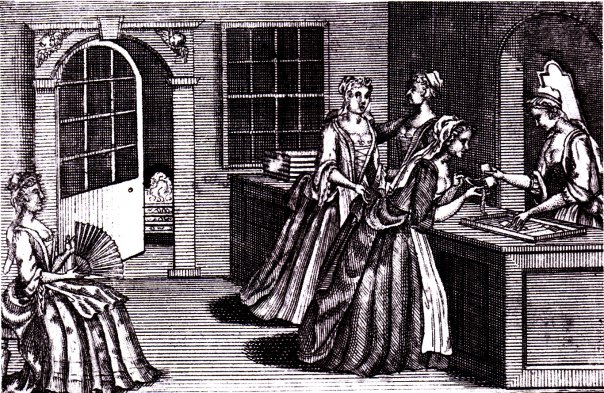
Lady at Toilette, Utrecht school, 17th century
Click on the link for a fun article on 17th century beauty.
Today I have a 17th century perfume recipe for you, taken from Polygraphice by William Salmon, published in 1685.

The recipe
To make Cyprian Powder.
Gather Musk moss of the Oak in December, January or Februarys wash it very clean in Rose-water, then dry it, steep it in Rose-water for two days, then dry it again, which do oftentimes: then bring it into fine Powder and fierce it: of which take one pound, Musk one ounce, Ambergrise half an ounce, Civet two drachms, yellow Sanders in powder two ounces, mix all well together in a marble mortar.

Another way to make the same.
Take of the aforesaid powder of Oak-moss one pound, Benjamin, Storax of each two ounces in fine Powder: Musk .Ambergrise and Civet of each three drachms, mix them well in a mortar.

 Breaking down the recipe
Oak moss Despite the name, this is really a lichen, Evernia prunastri, and has been used in perfumes since the Middle ages. The scent has been described as dry, woody, and smoky with a hint of tar. Used as fixatives in modern perfumes, or rather, a synthetic is, real oak moss is now forbidden, and is often used in men’s perfumes and in the perfume family that is called chypre.

Musk A common base notes in perfumery derived from glands from various animals. Today synthetic musk is almost exclusively used. Musk in large doses smells rather pungent, but diluted it is a warm, sweet and woody scent.

Ambergris A base notes in perfumery with a sweet, vanilla-ish scent with aquatic undertones. It comes from the intestines of sperm whales that habitually vomit out lumps of ambergris, which then age into scent maturity by the sea water. Though it is perfectly, even preferable, possible with ethically gathered ambergris, it is also very expensive and synthetics are almost always used today.

Civet Another animalistic base note, derived from the civet. It is similar to musk, but even more pungent concentrated and more sweet, smoky and sharp when diluted. Nowadays usually a synthetic.

Yellow sanders Wood from a tree, Zanthoxylum flavum. The scented and durable tree is on the brink of being endangered, unfortunately.

Other ingredients can be found at the ingredient list at the top of the page

My thoughts
I bought some oak moss last year and have wanted to try my hands at a Cyprian, or Cyprus powder for some time. It was a popular perfume in the 17th and 18th century as well as the 19th. In the 18th century it was popular to mix it into hair powder to scent it, but it can also be sewn into small sachets to be worn inside clothes or pockets. There are several recipes around and they are all rather alike. Unlike modern perfumes that consist of base, middle and top notes, this perfume is all base notes. Such notes are long-lasting and often quite heavy.  I’m going to make this recipe, as I have vegetal musk, civet and ambergris substitute that I want to try. It is a very easy recipe. Wash, dry, steep dry and pound. I have actually done the first steps. The oak moss is currently steeping and smells quite lovely of roses and rain wet forests.

Wednesday, April 24, 2013

Queen's Royal, a cosmetic mystery

Theophila Palmer Reading Clarissa by Joshua Reynolds, 1771
I have encountered a little mystery. At the very last page of Charles Lillie’s The British perfumer we find the following recipe, which completely stumps me. I have absolutely no idea what it is supposed to be used for. Lillie wrote his manuscript in the 1740’s though it wasn’t published until 1822. The publisher has kindly provided notes of enlightenment on several recipes, but not on this one.

The recipe
QUEEN'S ROYAL:
Take one ounce of brown ochre,
One ounce of vermillion,
One ounce of rose-pink,
One ounce of ivory-black,
 
Three ounces of essence of bergamot,
One and a half ounce of essence of lemon,
Half an ounce of oil of lavender.
Half an ounce of oil of carraways, A quarter of an ounce of oil of ambergris,
Half an ounce of oil of cloves,
A quarter of an ounce of oil of rosemary,
and Half an ounce of oil of cinnamon.
 
These are to be well mixed together; but care must previously be taken to reduce the first-mentioned ingredients into very fine powder.

My thoughts
The recipe is in two parts. In the first several, finely milled, pigments are mixed in brown, red, pink and black. The first three would make a reddish brown; the addition of black will make the colour darker and duller. Pigments were expensive so there must be a reason for them to be in there. They must be meant to give something colour.

The second part is purely scent. Bergamot and lemon essence with oils of lavender, caraway, ambergris, clove, rosemary and cinnamon. That’s a lot of scent and several of the oil is very strongly scented like cinnamon and clove. So this is clearly meant to smell. Mixing pigments and scent together would either give a scented pigment or a paste. It is a bit hard to say until you have tried as it depends on the ratio between powder and liquid. I lean on a paste, but I’m not sure. And what was it used for? I have a few ideas, but they are just theories.

A scented powder to make into sachets? I don’t think so. Too much valuable pigment to hide away. Had it was meant for that purpose, the scent would have been mixed with starch.

A rouge? I don’t think so either. With ¼ black pigment the shade would most likely to be too dark and unbecoming. Also, cinnamon and clove oils can sting and redden skin upon application and would be uncomfortable to have on your face.

Can in be a tinted perfume meant for hair powder? Might be, but in that case it needs to be mixed with hair powder. Now I know that 18th century recipes aren’t always constant, but the other scented powders in this book are placed together and they also have clear instruction of the ratio between scented powder and hair powder.

For tinting eyebrows? That doesn’t seem too unlikely, but why not say so? The colour could work for hair and to scent your eyebrows aren’t that far-flung, actually- I have encountered that notion elsewhere, though never in an 18th century context.

Then I got a suggestion from a friend, and, well, it doesn’t seem too unlikely. That would explain why it is tucked away at the last page and that it lacks any kind of direction. Could this be meant to rub into the hair of your nether region? It would tint it and scent it, and might that be something that would be considered attractive? I balked at the thought of cinnamon oil on those parts but I have been informed that today you can buy oils, often containing just cinnamon that are actually meant to be used down there for added stimulation. So can this be a more risqué cosmetics for ladies (and gentlemen) who dared? What do you think? Or perhaps you have an excellent idea of what this was really used for that I haven’t thought about. I would love to hear what you think!

Monday, April 22, 2013

Bathing beauties, 18th century style

There is a widespread view that people in the 18th century didn’t bathe and that is, perhaps, not completely untrue. There was a widespread belief that it was dangerous to the health to immerse the body in warm water. A warm bath was also a matter of economics, clean water was a luxury in most large cities and to that the added cost of getting, heating and disposing it. But during the century, bathing for health became more and more popular, preferable cooler bath and getting clean wasn’t the big issue, more a bi-effect. Not bathing, however, isn’t the same thing as not trying to be clean. Though the standard for cleanliness was certainly laxer than today, people did wash themselves. A small amount of warm water and a piece of cloth work quite well. There was also a reason for washing that we modern people perhaps don’t think about- vermin. There are a number of recipes, often water based tinctures with various herbs, that body and hair should be washed in regularly to keep lice and other creepy crawlies at bay.

Bathing and washing were quite a popular theme in art, often disguised as an ancient goddess, but here are a few pieces of artwork that seems to be a bit more anchored in reality. Please obeserve that nudity is afoot.
 
This robust beauty climbing out of her bath, could in all probability be a realistic depiction of a wealthy lady bathing. Her maids are ready with towels, one is getting something from the vanity and the bed is prepared for its mistress so she can rest after her ordeal. There is even a girl keeping watch so no one can peek at the naked lady.
 
Bather by Jean-Baptiste Pater, circa 1730
 
Bathing in the open did occur in the late 17th century, Louis XIV, for example, was a keen swimmer and both ladies and gentlemen of his court swam as well. And though I have yet to find anything about this habit occuring in the 18th century, it is plausible. And these ladies, bathing in their shifts do seem more grounded in reality than all the supposed godesses of the 18th century that usually bathe in the buff.

Summer by Nicholas Lancret
 

The Bathers by Jean-Baptiste Pater, first half of the 18th century

A little porcelaine lady preparing to wash from a basin.

Bathing nude by Hoechst
 
Perhaps the aim is clean feet, like Boucher's beauty below. This painting had a pendant, now lost. I wonder what it depicted.
 
A Young Woman Taking A Footbath by François Boucher, 1766
 
The bidet was very popular with aristocrats in France and Marie Antoinette is supposed to have owned several.

La Toilette intime ou la Rose effeuillee by Louis-Léopold Boilly

 An 18th century bathing shift in blue and white linen, owned by Martha Washington.

Click here for more information.
 
Mud baths were defintly taken for health reasons.

Late 18th century engraving
 
The most famous bather of the 18th century is probably Jean-Paul Marat who was famously killed by Charlotte Corday in his bathtub in 1793. He suffered from a skin disease and spent much of his time in a medicinal bath.

Death of Marat by Jacques-Louis David, 1793
 

Wednesday, February 27, 2013

FAQ

Possible self-portrait of Adélaïde Labille-Guiard, 1787

This blog now has a FAQ. This post have a permanent position above.

If you have any questions not covered in this FAQ, please don’t hesitate to contact me at isis.33 at passagen.se

  
Do you sell any products? No, I don’t. I have thought about it, but Swedish regulations make it much too expensive and difficult to do that on a hobby basis.

Where can I buy cosmetics made after historical recipes then? Try these shops:

Ageless Artifice They don’t have a web shop anymore, but they still sell products. You can read my review of several of their 18th century products here.

Little Bits on Etsy. I don’t have any personal experience of their products, but you can read American Duchess’ review here.

Sally Pointer I have only tried her white lead substitute, but she has done a lot of research into historical cosmetics and knows a lot about it.

Where do you shop for ingredients? You can find a list here.

Where do you find the recipes you use? By playing detective a bit. Searching Google books has proved a bit of a gold mine. Even if the books may not be available online, you at least get titles and authors. When reading books about cosmetics I take note of sources and check them out.

You seem to know a lot about historical makeup. Why don’t you write a book about it? Maybe… I have been thinking about it quite a lot, actually. If I do, though, I don’t think I would be able to pull it off writing it in English, but in my native Swedish.

You use [ingredient X] in a recipe and I’m allergic to that. Why do you use that if people are allergic to it? You can have allergies just about everything, so to provide recipes that no one is allergic to, is impossible. I try to be clear if allergic reactions are common, but I strongly urge anyone who wants to try any of the recipes found here, to do more research about the ingredients needed and to do a patch test.

How historically correct are you? As close as I can. I never use ingredients that are harmful for you and I try to steer clear from anything that are endangered, so recipes including such things are by necessity less correct. I try to find substitutes which are as close as possible to the original ingredient. I also make the recipes with modern equipment.

You wrote [statement y] which isn’t correct. Can I trust that what you write is true? My aim is to be as correct as possible. However, this blog is a research tool for me, not the end product. In other words, my research is ongoing and I constantly go back and revise. I may get things wrong or misunderstand things. If you think something I say is wrong, please ask. Or do a bit of research on your own- research is a great ways to exercise the brain cells.

You mostly write about the 18th century even if the blog title says it’s about historical makeup. Are you going to write about other time periods as well? My main interest lies mainly with the 17th and the 18th century, but I don’t want to restrict myself to that narrow period as I may very well want to write about cosmetics in a broader sense. As I have in a few posts already. I will probably not write much about the 19th century for the reason that there already is a blog that does that very well:

The Gibson Girl's Guide to Glamor

Sally Pointer also has a few articles on cosmetics.


Sunday, February 10, 2013

Honey water

 
Eliza Smith’s Compleat Housewife, or Accomplish’d Gentlewoman’s Companion,
 1727
After my post on hair powder I really had to look up the Honey water mentioned in the brown powder recipe. Curiously enough this perfume, despite the name, doesn’t contain any honey. It is also a long recipe; though I will try to break it down to make it easier to overview. 

The recipe
AQUA-MELLIS, OR THE KING'S HONEYWATER.

Take twenty-eight pounds of coriander seeds, ground small in the starch-mill; twenty-eight common bunches of sweet marjoram, in flower, dried and stripped from the twigs, one pound of calamus aromaticus, one pound of yellow saunders, and one pound of orange and lemon peel. Let the three last mentioned substances be separately beaten into gross powder.

Mix the above ingredients, and put them into a sixty-gallon copper-still, and add to them twenty gallons of proof spirits, and the same quantity of rain or spring water.Lute well all the junctures of the apparatus, and leave the ingredients in this state, without fire, for forty-eight hours. At the end of this time, begin to distil by a very gentle heat, lest the flowers and seeds, which are very light, should rise suddenly in the still-head, stop up the worm, and endanger the whole work.

Increase the fire after the first half hour, and keep it regular, thereafter, till the termination of the process.

Draw off about twenty-six or twentyseven gallons, or continue so long as the spirit will burn, by the application of a lighted paper to a small quantity of it in a saucer.

Next day, when the still is perfectly cold, let it be well cleaned out, saving the remaining ingredients for further uses, as will be after directed.

Now return the spirits drawn off yesterday into the still, and add thereto ten or twelve gallons of water. Then put in the following nine ingredients, bruised andmixed as directed. These are to remain in the liquor, in a cold state, for forty-eight hours; attention being still paid to luting and stopping close, as before.

At the end of this time, kindle the fire, and work off (slowly at first) as before, until twenty-six gallons are distilled. Mix all the different runnings together in a copper vessel, kept for this purpose only; and, as for what may come over after the twentysix gallons, it must be kept, and added to the ingredients used for the making of the next quantity of Hungary water.

The nine ingredients alluded to above, are as follows :—

Fourteen ounces of nutmegs, Four ounces of cloves, Twelve ounces of cinnamon bark, Eight ounces of pimento, and Forty ounces of cassia lignum. These are to be separately broken or bruised in an iron mortar, until they are about the size of small peas. If there be any dust, it must be sifted from them before they are used.

When the above are broken, take Forty ounces of storax, Forty ounces of gum benjamin, Forty ounces of labdanum, and Forty venellios, by tale. Break and bruise the above also, but make as little dust as possible. Put the dust from these and the foregoing, together, into a coarse muslin bag, which is to be hung in the still, so that the liquor, during distillation, may extract all its virtues.

Having drawn off, in this second distillation, just twenty-six gallons, add to it, in a copper vessel, that will hold forty gallons, six gallons of orange flower-water, and eight gallons of rose-water, which has been recently made.

Now mix together ten ounces of spirit of musk, ten ounces of spirit of ambergris, half an ounce of true oil of lavender, half an ounce of good essence of bergamot, and half an ounce of oil of rhodium.

When properly mixed, put all these into the copper vessel, and stir the whole well together. It would be better, however, if

these strong perfumes were put in before the orange-flower and rose waters.

Add to all these a quart of milk, which has stood for a night, and which has had all the cream taken clearly off:, then agitate and mix the whole well together, and stop the vessel up close, until the time when it is to be used.

Remarks.

The jar ought to have a lock-cock soldered into it, to prevent accidents. This should be placed fully two inches from the bottom, in order that the milk, and other impurities, may fall to the bottom, and not flow through into the vessels in which it is drawn off for use.

If this honey-water be made in the spring, about March or April, and if the weather be fair, it will be quite fined down in the course of a month; that is, if it be not opened or disturbed. When the perfumer finds, by drawing off a little in a glass, that the milk, &c. have fallen down to the bottom, he may draw the whole off into clean andwell-seasoned stone, or glass, bottles; or much rather into another copper jar.

This composition ought never to be drawn off in rainy or cloudy weather; for then the milk is apt to rise. In warm weather it should be kept cool; and, in winter, as warm as possible. When distilled in the winter, the jars ought to be warmed, otherwise the honey-water will not be fined for five or six months.

If the honey-water be twenty years old, so much the better.

The ingredients from the first distillation should be immediately dried in the sun, otherwise they will become mouldy. When there is a considerable quantity from three or four makings, it ought to be ground in a mill, and finely sifted. They will be found to be of great use in the making of ordinary brown wash-balls,- and, with some additions, of brown powders for the hair.

The ingredients from the second distillation are of much greater value than the above, and therefore require more care in the drying. These are of great use for the best sort of gross powders, for sweet bags, &c.; and, if made into a fine powder, may be made use of, with great success, in the best sort of brown perfumed balls.

The same powder, with fresh ingredients, makes excellent pastils, to burn; and may be further used in making spirit of benjamin. For all these uses, it is necessary to attend to the receipts which will hereafter be given./ The British Perfumer 
Source

Breaking down the recipe
Ingredients that have been described in earlier posts can be found in the ingredients list on the top of the page.

First stage
Coriander seeds An herb, with a citrusy flavor. Very common in Indian cuisine.
Marjoram An herb with a citrus and pine flavor.
Calamus Aromaticus
Yellow sandalwood Aromatic tree. A common ingredient in scents
Orange and Lemon peels The dried peels of the fruits.

There ingredients are steeped in alcohol and water before being distilled. The remains of the spices are saved and dried and the liquid is returned to the still.

Second stage
Add more water and add:

Nutmeg Spice. Dried seeds. Used in cooking, but can be poisonous in large quantities.
Clove
Cinnamon
Pimento A little tricky, perhaps- Pimento can mean a red pepper but it can also mean Allspice, and that is what it means here. That spice is the dried fruits of the of the Pimenta dioica plant
Cassia Sometimes called Bastard cinnamon. Has less taste and rougher texture than true cinnamon and is therefore cheaper.
Storax
Gum Benjamin or Benzoin resin
Labdanum
Venellios Tonka bean, a fragrant seed of the Tonka bean tree; used in perfumes and medicines and as a substitute for vanilla. EDIT: After further research, Venellios is NOT Tonka bean, but an inferior quality of Vanilla. Tonka would probably work well as a substitute, though.

Let it steep again and then distill. Once again the remains are saved and dried, but keep them separate from the first remains.

Third stage
Add

Spirit of Musk Animalistic scent originally derived from the glands from various animals, like musk deer. Today synthetic musk is almost exclusively used. Probably the most common base note in perfumes. Spirit of musk is an alcohol extract.
Spirit of Ambergris Ambergris is a waxy substance that comes from the digestive tracks of Sperm whales. Prepared it smells wonderful and has been used as fixative and base note in perfume for a long time. It can be ethically harvested, but the price is very high so usually synthetic substitutes are used. Spirit of ambergris is an alcohol extract.
Lavender oil
Bergamot essence Comes from Bergamot orange, which looks like a yellow orange. Used in scents and to flavor Earl Grey tea.
Rhodium oil, or Rosewood oil
Orange flower water A distillation of fresh bitter-orange blossoms
Rose water
Milk

Stir and leave it to settle

Fourth stage
When the milk, along with any impurities has settled at the bottom, decant the perfume into suitable bottles.
 
The dried remains can be used to perfume scent bags and powder.

My thoughts
There are a lot of ingredients in the recipe and with steeping and distilling it takes several days to come to the end of the third stage. The recipe suggests that the fourth stage will take months. The recipe also has huge quantities, which isn’t surprising as Charles Lillie was a perfumer by trade. I would really like to try this one, on a much smaller scale, of course. Most of the perfume recipes I have read demand real ambergris and musk, which would mean trying to convert it, as essence if what I can get my hand on. This recipe, as you can see, doesn’t need any such thing.

The problem that needs to be solved is the distillation process. Steam distillation in short, short is boiling water, making the steam go through the scent matter, leading the condensed liquid into another container and cool it. Hey presto, scent! I don’t really have the room to by any fancy apparatus, but I have found some simpler arrangements, like this one. For a smaller amount, it does seem to be doable.
 
I wonder if the perfume turns out spicy or flowery. The first batch of ingredients all have a citrusy scent, which ought to mean that the top notes will have a lemon quality. Then it would have spicy/resinous middle tones and muck and ambergris as base. Sounds quite a lot like a perfume I would enjoy!
Alchemy satire, 18th-century artwork

Friday, November 23, 2012

Shopping for ingridients

I get regular questions on where I buy the ingridients to my recipes. Here is a list of the online shops I have purchased from so far. I have also found what I need in food stores, health food stores and stores that sells art supplies.

Alchemy Works US-based. I have bought synthetic civet and ambergris. Also sells resins and herbs.

Mountainrose Herbs US-based. Herbs, spices and oils, many of them organic. Sadly they stopped shipping overseas just after I recieved my first order.

Naturkosmetikmagasinet Swedish-based. Herbs, essential oils and various comsetic bases. Also sells bottles and jars.

Naturally Thinking UK-based. Essential oils, jars bottles and various cosmetic bases.

The Perfumer's Apprentice US-based. Sells perfume bases and blends

Sally Pointer UK-based. I have purchased white lead substitute as well as cometic grade Iron oxide. Sells other histoical cometics as well.

Spådom Swedish-based. Have a nice collection of resins like labdanum and bensoe.

TKB Trading US-based. Cosmetic ingridients. I have bought carmine, bismuth and real pearl powder from them.

Örtagubben Swedish-based. Herbs and essential oils.


Sunday, November 11, 2012

Learning by doing

A large part of this blog is that I am by no means an expert on historical beauty. Passionate about it and interested, but I am constantly learning more and sometimes I need to retract from previous statements, simply because I have learned more, or because I have misunderstood something. Like the following.

Lead white can be substituted with Titanium dioxide. The problem with this statement is that I have never actually tried comparing the two. However, Sally Pointer has and has found that the best substitute is actually Titanium dioxide, corn starch and Talc! She sells that her web shop and I have ordered it to try out.

Cuttlefish bones. Here I stumbled because English isn’t my native language and I naively thought it was the same as fish bones and have this treated it equally in recipes. Not so, which I am sure most of you already know. A cuttlefish belong to the same family tree as squids and octopuses and the “bone” is a kind of porous internal shield, basically made out of aragonite, a crystal form of calcium carbonate. So even if I haven’t been completely wrong with equaling it with calcium carbonate, the texture is different. Cuttlefish bones are easily obtained in pet stores. If you ever kept birds, then you have probably given it to your birds. It’s very easy to ground, given its porous nature, so next time I use a recipe with it as an ingredient, I will try it.

Bismuth. Additional information- I was unsure if Bismuth discolours, and have now learned that it does, it can become greyish. So the recipes from this post seem to indicate that it is Bismuth and not real pearl powder that has been used.

In addition to the Lead substitute I have ordered some bismuth. Just for testing as I am allergic to it, but I plan a post where I test all the white pigments I have to compare them. I would like to see how Bismuth really looks along the substitute I have used, Titanium dioxide with mica. In the same order I will also get some Carmine, so some rouge posts are coming up as well. As with the patch post. I found that the more I looked, the more I found when it came to beauty patches and I have had to stop my research. Not because there aren’t more to be found, but because this is “just” a blog and not an academical paper. It’s turning out both long and picture filled, so it will probably be posted in two parts and hopefully pretty soon.